Wizards and scientists have always seemed to belong to opposite worlds: one to wonder, the other to method. But in truth, they share a common beginning. Both are seekers. Both observe, test, fail, refine, and discover. In that sense, wizards were the very first scientists. Long before laboratories, satellites, and space agencies, there were alchemical thinkers imagining the hidden rules of matter, heat, light, motion, and transformation. Their experiments and discoveries laid the imaginative foundation for the technologies we use today, including the astonishing machines that carry humanity into space.
The Alchemical Wizards in the “Magical Elements of the Periodic Table” series embody that ancient curiosity. Caelkoth explains how “cesium” or “caesium” plays a role in ion propulsion engines, helping spacecraft achieve efficient and long-lasting thrust. That idea feels perfectly wizardly: a small element, seemingly ordinary, becomes a key to moving across the vastness of space.
Hetha, from book 1 of the Alchemical Wizards, teaches that “helium” is used in cooling gases for space telescopes, showing how an element known for its lightness and invisibility can help protect delicate instruments that peer into the universe.
Strauna points to “strontium”, noting its promise in materials for space exploration because of its light weight and strength. Together, these examples reveal a larger truth: space travel is built on the careful use of elemental properties—strength, stability, conductivity, heat resistance, magnetism, and precision.
Other wizards in the series share knowledge about more elements that have helped the human race reach beyond Earth. In doing so, they remind us that the periodic table is not merely a chart of substances, but a map of possibilities. Each element has its own “magic,” and when humans learn to understand that magic, they turn it into practical power: propulsion, shielding, sensors, electronics, alloys, optics, and life-support systems. Spacecraft are, in a very real sense, modern spellbooks written in metal, glass, and code.
“Argon” is used in some spacecraft systems and manufacturing processes because its inertness helps protect sensitive materials from unwanted reactions.
“Boron” is valued in advanced lightweight composite materials and radiation-shielding applications for aerospace use.
“Bromine” appears in specialized flame-retardant materials and certain aerospace chemical processes.
“Cerium” is used in polishing compounds for precision optics and in some specialized alloys and materials.
“Cobalt” is important in high-temperature superalloys used for demanding aerospace environments.
“Gadolinium” has applications in specialized magnetic materials and advanced imaging and detection technologies.
“Germanium” is used in infrared optics and certain high-performance solar-cell and sensor technologies.
“Iridium” is prized in spacecraft components because it can withstand extreme heat and harsh conditions.
“Lanthanum” is used in optical glass and advanced materials for aerospace and space instrumentation.
“Manganese” contributes to strong, lightweight alloys used in aerospace structures.
“Niobium” is used in high-temperature alloys and superconducting technologies relevant to space science.
“Phosphorus” is essential in semiconductor materials and electronics that support space systems.
“Radon” has limited practical use in space industry applications due to its radioactivity, but it is studied in radiation science.
“Rhodium” is used in high-performance coatings and components that resist corrosion and heat.
“Scandium” is important in lightweight, high-strength aluminum alloys used in aerospace engineering.
“Tellurium” is used in specialized semiconductor and solar-energy technologies for space applications.
“Thulium” has niche uses in lasers and advanced optical systems that can support space technology.
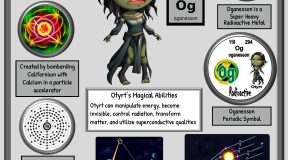
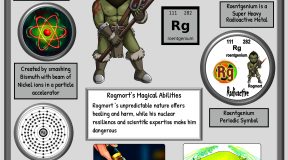
The “Magical Elements of the Periodic Table” book series invites readers to see chemistry as a kind of enchantment—one grounded in reality, but no less marvelous for being true. Through the wisdom of the Alchemical Wizards, we learn that the path to space was never only about rockets and equations. It was also about imagination, experimentation, and the courage to ask what matter can do. In that way, the oldest magic and the newest science are part of the same story.
Learn more about the Alchemical Wizards and the elements they represent in the Magical Elements of the Periodic Table book series at magicalptelements.com.